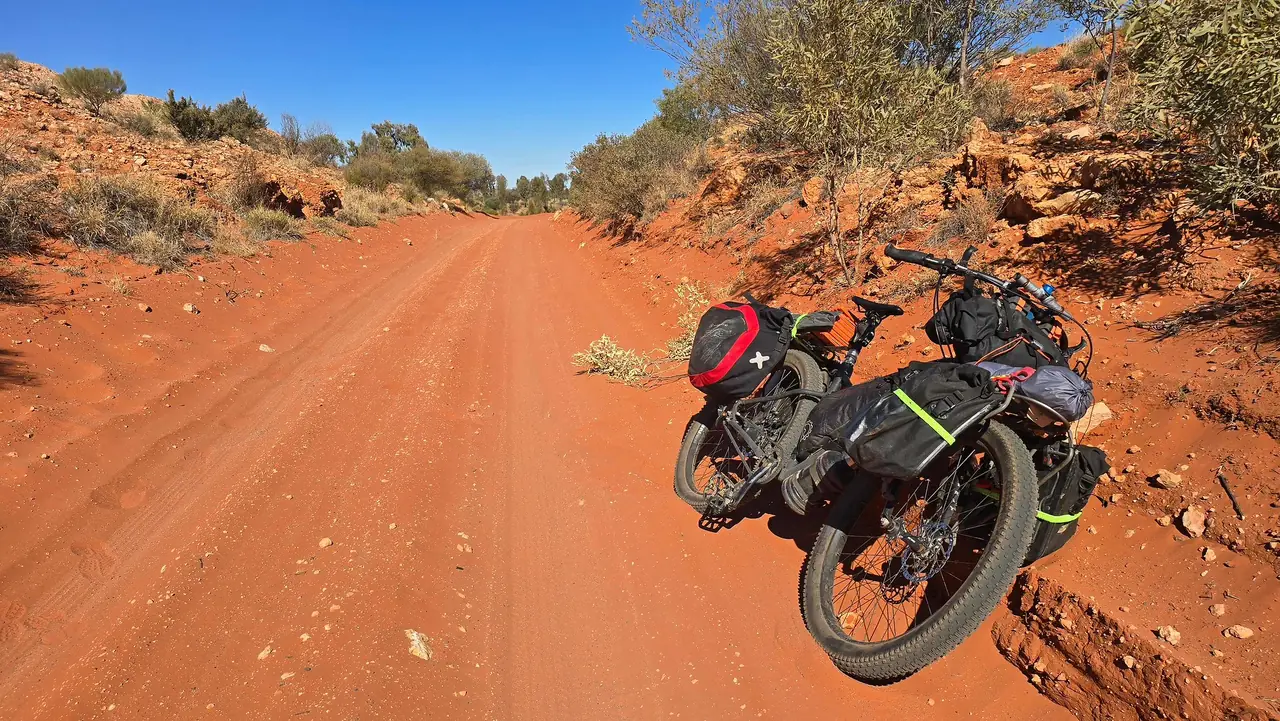
 Near Titjikala, Northern Territory
Bikepacking
Find your bike
Your body measurements in. Bike type and sizes out, on a bike you can spin.
A bike that fits is the difference between a long day and a long week. Put in your height, inside leg, shoulders, hands and feet, and how you ride, and this page works out what the professional fitters' published methods say: the bike type, the frame size, the saddle height, the stack and reach to compare, the bar width, the crank length and where your feet go.
What this is, and isn't. These are the starting points the pros agree on, from the LeMond formula, Dan Empfield's stack and reach, Lennard Zinn's crank rule and Steve Hogg's cleat tables. They are not a bike fit. Flexibility, old injuries and the way you pedal move every number, and the formulas disagree with each other by 5 to 15 mm. Use these to shortlist a bike and set it up; then ride, adjust, and see a fitter if anything hurts.
Your numbers
Measure in bare feet, in centimetres. The guide below shows how.
How to measure
Bare feet, a wall, a hardback book and a tape. Do each one twice and average it; the numbers above are only as good as these.
- Height. Back to the wall, heels together, look straight ahead. Floor to the top of your head.
- Inside leg. Feet 15 cm apart, push a hardback book firmly up into your crotch, spine level. Floor to the top of the book. This is the number everything else scales from, so do it three times.
- Shoulder width. Someone else measures between the bony points on the very top of each shoulder, where the collarbone meets the shoulder blade. Not the outside of the arms.
- Hand length. Tip of the middle finger to the crease at the base of the thumb.
- Trunk. Sitting upright, the notch at the top of your breastbone down to the crotch.
- Arm. The bony point of the shoulder to the centre of a clenched fist.
- Shoe size. Your cycling or walking shoe size. Used for where the ball of your foot sits over the pedal.
On the bike
Then check your knee
Saddle height formulas are all chasing the same thing: a knee bent about 25 to 35 degrees at the bottom of the stroke. The research found 25 degrees used the least oxygen. If your hips rock on the saddle, it's too high; if your knee is bent much past 35, it's too low.
Take it with you
Your summary
Copy this into your notes or hand it to a bike shop or fitter.
-
 Phone · tilt to steer
Stay On
Now keep a loaded bike upright past magpies, roos, dogs and road trains.
-
 YouTube
Bikepacking365
Real rides on a loaded fat bike: red dirt, alpine fire trails and the long way round.
-
 Shop
ShopBikepacking365 shop
Shirts, mugs and prints for people who'd rather be on the bike.
Methods: LeMond/Guimard saddle height; Holmes knee angle and Peveler (2008); Dan Empfield's stack and reach; Lennard Zinn's crank rule; Steve Hogg's cleat tables; Canyon's height-to-inseam ratio; Adventure Cycling Association geometry guide. Nothing here is medical advice. No data leaves your browser.